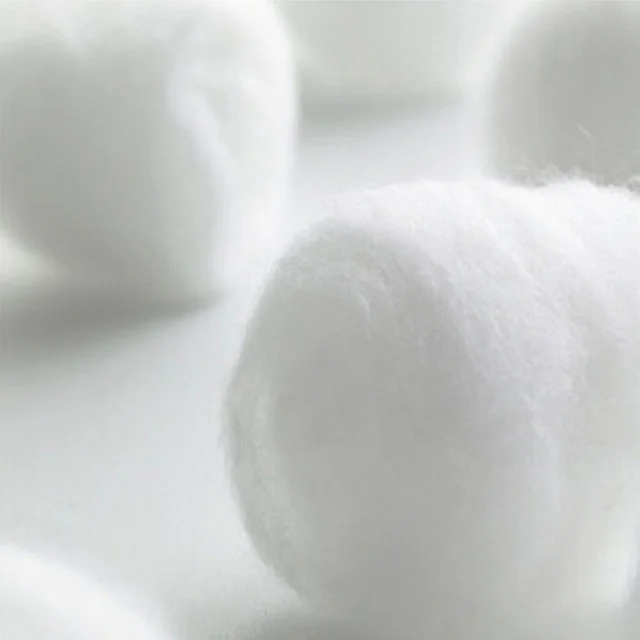
Cotton Ball
Bulk 0.3g-10g Cotton Balls for medical
The absorbency of cotton balls is a key indicator of their quality, particularly for medical and personal care uses. Here are the standards and criteria to determine if a cotton ball's absorbency is c…
MOQOn request
SterilisationEO / non-sterile
PackingBulk or private label
OriginTaizhou, Jiangsu
- ISO 13485 quality management system
- In-house EO sterilization and microbiology lab
- COA, MSDS and technical file with every shipment
Product overview
The absorbency of cotton balls is a key indicator of their quality, particularly for medical and personal care uses. Here are the standards and criteria to determine if a cotton ball's absorbency is considered good:
Absorbency Standards for Cotton Balls
- Absorbency Capacity :
- Good Product : A high-quality cotton ball should absorb at least 10 times its own weight in liquid.
- Poor Product : A cotton ball that absorbs less than 7-8 times its own weight is typically considered lower quality.
- Absorbency Speed :
- Good Product : Should quickly absorb liquid, ideally within a few seconds.
- Poor Product : Takes a noticeably longer time to absorb liquid.
- Retention Capacity :
- Good Product : Should retain absorbed liquid well without dripping when held up. The cotton ball should not release a significant amount of liquid when lightly squeezed.
- Poor Product : Easily releases liquid when lifted or lightly squeezed, indicating poor retention.
- Distribution of Absorbed Liquid :
- Good Product : The absorbed liquid should be evenly distributed throughout the cotton ball.
- Poor Product : Uneven distribution of liquid, with some parts remaining dry while others are overly saturated.
Testing Methods
- Weight Method :
- Weigh a dry cotton ball.
- Submerge it in water for a set amount of time (e.g., 30 seconds).
- Remove the cotton ball, let it drain for a few seconds, and weigh it again.
- Calculate the weight difference to determine the amount of water absorbed.
- Compare the absorbed weight to the dry weight to ensure it meets the standard (at least 10 times its dry weight).
- Time Method :
- Place a cotton ball on a surface and add a specific amount of liquid.
- Measure the time taken for the cotton ball to fully absorb the liquid.
- A good product will absorb the liquid quickly, typically within a few seconds.
- Retention Test :
- Soak the cotton ball in water, then hold it up to observe if any water drips out.
- Lightly squeeze the cotton ball to see how much water is released.
- A high-quality cotton ball will not drip significantly and will release minimal water when squeezed lightly.
Industry Standards
Different organizations and countries may have specific standards for medical-grade cotton absorbency. For example:
- USP (United States Pharmacopeia) standards may specify certain absorbency requirements for medical-grade cotton.
- ISO (International Organization for Standardization) standards, such as ISO 9073-6, provide guidelines for testing the absorbency of nonwoven materials, which can be adapted for cotton balls.
Key Quality Indicators
- Appearance : Should be pure white and uniform in color.
- Texture : Should be soft and fluffy, without being too loosely packed.
- Purity : Should be free from any contaminants, chemicals, or residues.
By adhering to these standards and testing methods, you can ensure that the cotton balls you are using or producing are of high quality, with excellent absorbency suitable for medical and personal care applications.
Related
See the family